
Sales teams today aren’t struggling with a lack of leads — they’re struggling with knowing which leads actually matter. Between disconnected tools, manual qualification processes, and subjective scoring, most teams often end up prioritizing the wrong prospects, slowing down sales cycles. According to HubSpot, 28% of sales professionals cite lengthy sales processes as the primary reason good prospects back out of deals. Lead scoring automation tools simplify reps’ workflows and improve sales process efficiency.
Implementing lead scoring automation software unifies data across touchpoints, applies consistent scoring logic, and enables real-time insights, helping sales teams focus on actually selling. With the right B2B lead scoring automation tool, sales and marketing teams can reduce misalignment, move faster, and focus on the leads most likely to convert.
This guide explores lead scoring automation software in detail, covering the best tools for sales and marketing teams in 2026 that can help reduce manual work, improve sales-marketing alignment, and deliver measurable gains in conversion rates and sales efficiency.
What Are Lead Scoring Automation Tools?
Lead scoring automation tools are software platforms that assign numerical values to leads based on predefined criteria, behavioral patterns, and predictive signals. They evaluate prospects automatically by analyzing attributes such as job title, company size, website engagement, email interactions, and content consumption patterns in real time, replacing manual qualification with continuous, real-time scoring as new data becomes available.
Lead scoring automation software falls into two categories:
- Traditional or rules-based systems that apply fixed scoring logic determined by sales and marketing teams
- Predictive models that use machine learning algorithms to identify patterns in historical conversion data
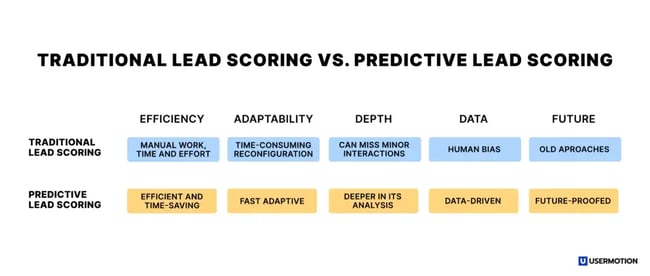
Both approaches aim to simplify effective lead management and help revenue teams prioritize outreach, allocate resources efficiently, and focus selling efforts on prospects most likely to convert.
How Do Lead Scoring Automation Tools Work?
Lead scoring automation tools function by ingesting data from multiple sources across the customer journey, applying scoring logic to each data point, and outputting a composite score that represents purchase intent or qualification level.
- The lead scoring automation process begins once a prospect enters the system through form submissions, website visits, email engagement, social media interactions, or third-party data integrations.
- The lead scoring engine then evaluates each interaction or attribute against established parameters.
In traditional or rules-based systems, predetermined point values are assigned to specific actions or characteristics. For example, sales and marketing teams could define a scoring system that assigns 10 points for downloading a pricing guide, 5 points for attending a webinar, or 20 points for visiting the pricing page three times in one week. Firmographic criteria may be treated similarly, with larger companies or specific industries receiving higher scores based on alignment with the ideal customer profile.
In predictive lead scoring automation tools, the approach differs. The software analyzes thousands of historical leads to identify which attributes and behaviors correlate most strongly with closed deals. Machine learning models detect patterns that human teams might miss, such as the significance of viewing specific product pages in a particular sequence or the predictive value of engaging with certain email subject lines. The algorithm continuously refines itself as new conversion data becomes available.
Whether through a rules-based system or predictive lead scoring, once lead scores are calculated, the automation platform typically triggers configured workflows based on threshold criteria. For example, high-scoring leads may automatically route to sales representatives via lead distribution software, enter nurture sequences, or receive priority status in the CRM.
The system also dynamically updates lead scores as prospects continue to interact across various touchpoints, ensuring sales teams always have up-to-date intelligence on which opportunities warrant immediate attention.
The key components that support this process include:
- Data integration layers that connect CRM systems, marketing automation platforms, website analytics, email tools, and third-party data sources
- Scoring logic engines that apply rules-based formulas or machine learning algorithms to incoming data
- Threshold management systems that define when leads qualify for specific actions or handoffs
- Workflow automation capabilities that trigger follow-up actions based on score changes
- Reporting dashboards that track scoring performance, conversion rates by score range, and model accuracy over time
Features to Look for in Lead Scoring Automation Software
Evaluating and choosing from the wide range of B2B lead scoring automation tools requires looking beyond surface-level functionality. The best lead scoring automation platforms offer customizable scoring criteria, real-time score updates based on behavioral signals, and unified data across marketing and CRM systems to prevent fragmented decision-making. Tools that connect lead scores directly to automation workflows and sales handoffs perform better in sales environments where speed, alignment, and consistency directly influence conversion rates.
1. Customizable Scoring Criteria
Accurate lead scoring should reflect the organization’s business model rather than generic assumptions. The best B2B lead scoring automation tools enable teams to assign scores based on specific demographic and firmographic attributes — such as job title, company size, or industry — as well as behavioral signals like form fills, page views, or email clicks. This flexibility ensures that lead scores align with your ideal customer profile and buying journey, not with generic best practices.
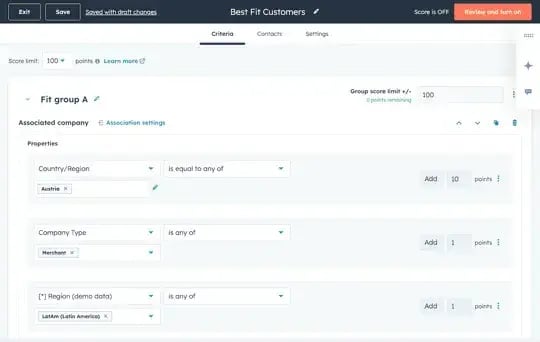
Customizable scoring criteria allow teams to build a scoring model that accurately reflects what a qualified lead looks like for their specific business, product, and sales motion — making it one of the most important features to evaluate when selecting a lead scoring automation platform.