
A sales content management platform centralizes sales-approved content in a single source of truth, making it easier for revenue teams to find, share, and track the materials that move deals forward. In a landscape where more than half of sales leaders report using sales enablement content, and 79% say those materials are essential for closing, choosing the right platform has become a strategic decision, not just an operational one.
Yet the gap between having usable content and having just content remains wide. These are symptoms of scattered storage, poor version control, and a lack of connection between content engagement and pipeline outcomes.
This guide explains what a sales content management platform does, which features matter most for growing teams, and how the top platforms in 2026 compare on content governance, analytics, CRM integration, and AI-powered findability.
What is a Sales Content Management Platform?
A sales content management platform is software that organizes, distributes, governs, and tracks sales-facing content across an organization. Unlike a general-purpose CMS designed for website publishing or a digital asset management (DAM) tool built for brand media, a sales content management system is purpose-built for revenue teams. It enforces content governance through approvals, versioning, and expirations, while supporting role- and region-based access controls, ensuring that sellers always work with current, compliant materials.
At a functional level, a sales content management platform delivers recommended content based on deal stage and buyer context, then integrates with CRM systems to link content usage to opportunities. This CRM-native reporting connects content engagement signals to pipeline stages and outcomes. That visibility shows enablement leaders which assets actually influence revenue, instead of just which ones get downloaded.
The content lifecycle governance built into these platforms typically includes the following steps:
- Create
- Review
- Approve
- Publish
- Update
- Expire
- Archive
Governance roles include content owners, approvers, compliance reviewers, and enablement admins, each responsible for different phases of that lifecycle. Without this structure, content libraries become what many salespeople are used to encountering: graveyards of outdated decks and orphaned one-pagers that erode seller confidence and buyer trust.
Why Sales Teams Need a Sales CMS
Sales content management platforms solve three problems that spreadsheets, shared drives, and general-purpose storage tools cannot: findability, governance, and attribution. When content is scattered across Google Drive folders and email attachments, sellers default to whatever they can find fastest, which is rarely the most current or effective asset.
The data makes the case clearly. Sales enablement strategies that include structured content management contribute to 49% higher win rates on forecasted deals, according to multiple industry benchmarks. And yet only 35% of sales teams currently track their content’s effectiveness. That gap is one that a dedicated platform is specifically designed to close.
Beyond findability, a sales CMS protects brand consistency. In regulated industries like healthcare, financial services, and legal, sending outdated compliance materials or unapproved pricing documents creates liability. Even in less regulated environments, off-brand content damages credibility and introduces confusion during multi-stakeholder buying cycles.
What to Look for in Sales Content Management Software
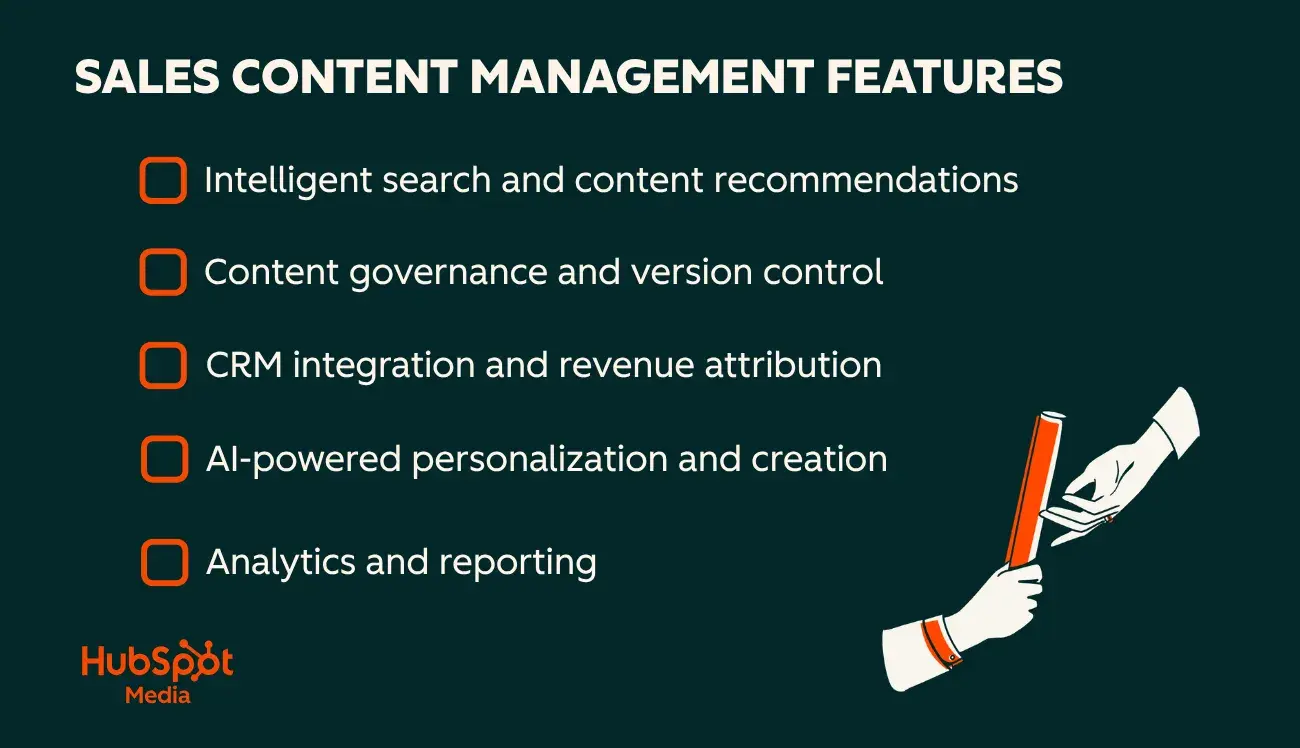
Sales enablement leaders evaluating content management platforms should prioritize capabilities that directly improve seller adoption, content quality, and revenue attribution. The five features below represent the highest-impact differentiators between platforms that warehouse content and platforms that activate it.
1. Intelligent Search and Content Recommendations
A sales content management platform improves content findability by using AI-powered search, contextual tagging, and deal-stage recommendations to surface relevant materials without manual browsing. Intelligent search eliminates the hunt — where sellers sift through folders hoping to find the right deck — and replaces it with instant, context-aware results. The best systems learn from usage patterns and engagement data, automatically promoting high-performing assets.
Sales content analytics should measure rep adoption and asset usage by team and stage, so enablement leaders can see not just what’s being used but what’s being used successfully.
Pro tip: Look for platforms that recommend content within the CRM or email workflow, not just inside the content library. If sellers have to leave their deal workspace to find content, adoption will always be lower than it could be. Even small amounts of friction add up.
2. Content Governance and Version Control
Content governance determines whether the library stays useful over time or degrades into clutter. A strong platform enforces approval workflows, automatic expiration dates, and version tracking so that every asset in the system is current, compliant, and owned by a named stakeholder. Without governance, content libraries grow unchecked — filled with files named things like “Pitch-Deck_v5-FINAL-use_this_one” — and outdated materials end up in front of buyers.
Role-based permissions ensure that only approved users can publish, edit, or retire content. Region-based access controls further segment the library for global teams operating under different compliance requirements or product lines.
Best for: Organizations with multiple product lines, regional teams, or compliance requirements that demand strict control over what sellers can share externally.
3. CRM Integration and Revenue Attribution
A sales content management platform integrates with CRM systems to link content usage to opportunities, giving revenue leaders a clear line from asset engagement to deal outcomes. This capability is what separates a content library from a revenue intelligence tool. When a rep shares a case study during a mid-stage opportunity, and the buyer spends eight minutes with it before the deal closes, CRM-native reporting connects that engagement signal to the pipeline stage and outcome.
Without this integration, enablement teams can’t prove ROI, which remains one of the most persistent challenges in sales management. Platforms that log content activity directly into deal records provide the attribution data needed to justify content investment and guide future production.
What to look for: Platforms where content engagement data appears on the deal timeline inside the CRM, not buried in a separate analytics dashboard that managers have to remember to check.
4. AI-Powered Personalization and Creation
AI has moved beyond search and recommendation into content creation and personalization. According to the Content Marketing Institute’s 2026 B2B research, 45% of B2B marketers plan to increase their investment in AI-powered marketing tools in 2026.
The most capable platforms in 2026 use AI to generate first drafts of sales emails, customize pitch decks with prospect-specific data, and dynamically assemble content packages based on buyer persona and deal stage. This capability reduces the time sellers spend adapting generic materials and increases the relevance of every touchpoint.
Pro tip: Evaluate whether AI features work inside the CRM and email client, not just inside the content platform. AI that generates a perfect email draft is only useful if the rep can access it during the actual workflow.
5. Analytics and Reporting
Sales content analytics measures rep adoption and asset usage by team and stage, giving enablement leaders the data to optimize their content library rather than just expanding it. Strong analytics answer questions like:
- Which assets are sellers actually using?
- Which content correlates with closed-won deals?
- Where in the funnel do buyers disengage?
Without robust reporting, content investment is based on intuition rather than evidence. Platforms that surface engagement data at both the asset and deal level give enablement teams the insight they need to retire underperforming content, replicate what works, and demonstrate the business impact of their programs.